
May 13, 2026 ~ Shabbat KALA. Maqam HOSENI.
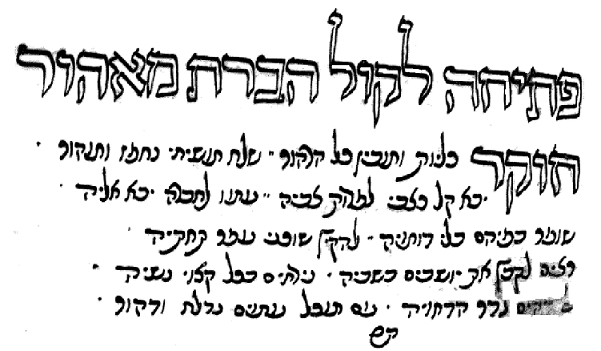
Mahour - מאהור - is a higher pitched version of Maqam Rast. The way to end each stanza in Maqam Mahour is at a high tone, instead of a low tone; that is, it starts lower and ends higher.
Ma'hour means chagrinned and disappointed in Arabic. The maqam expresses anxiety and emotional distress.
According to Red Book, only used twice a year; Shabbat Toledot & Balaq. During these two Torah portions, both Esau and Balaq are disappointed and angered. Mahour can also be applied for Shabbat Sheqalim, and according to Abraham E. Shrem and Gabriel A. Shrem, also for Shabbat Vayigash.
Maqam Mahour, or in Egypt, Nagham Kerdan, is the same scale as Maqam Rast, but in the early 20th century practice, the term "Rast" was often use to mean Suznak. The term Mahour/Kerdan also usually implies that the upper part of the scale will be developed.
| Pizmon | Page | Song | Commentary | Recordings | Application |
|---|---|---|---|---|---|
| 168 | 145 | ענני רחמן | Hamaoui Manuscript Tabbush Manuscript |
Arabic |
|
| 169 | 145 | חסדך קדם |  Raphael Tabbush Shabbat Bereshit, the Shalosh Regalim, as well as Purim. Tabbush. Turkish. Raphael Tabbush Shabbat Bereshit, the Shalosh Regalim, as well as Purim. Tabbush. Turkish. |
G. Shrem Kedusha I. Cabasso - Qedusha G. Shrem Recording R Elnadav- Naqdishakh Y Nahari- Qedusha Nahari- Nishmat I Cabasso- Naqdishakh I CABASSO QEDUSHA I CABASSO QEDUSHA I CABASSO QEDUSHA |
נקדישך |
| 170 | 146 | אל חון על בת המענה |  Baby Girl. Baby Girl. |
I. Cabasso - Hahodaot G. Shrem Recording Moshe Dwek Moshe Dwek - EH Moshe Dwek - Qaddish Moshe Dwek - Mimisrayim Moshe Dwek - Naqdishakh Moshe Dwek - Naqdishakh I CABASSO EL HAHODAOT I CABASSO MIMISRAYIM |
ה' מלך |
| 171 | 146 | רצה נא | Raphael Tabbush Salah Abd ElHai singing the Arabic "'Ishna WeShofna". This includes a Sama'i and Mawal. In 1939, Ashear used the pizmon Resseh Na on page 146 for Qaddish. |
Arabic- Salah Abd El Hai E. Menaged E. Menaged 2 Recording Y Nahari- Qaddish Maury Blanco S Antebi- Qaddish |
קדיש |
| 172 | 147 | אל לעבדך | Hamaoui Manuscript Tabbush Manuscript |
Kaddish - Recording Hayim Eliyahou- Qaddish Maury Blanco |
קדיש |
| 173 | 147 | רם בך יגל לבב | Raphael Tabbush Hamaoui Manuscript Tabbush Manuscript |
S. Salem S. Salem 2 G. Shrem Recording |
|
| 174 | 147 | יחיד האל ומהלל | Raphael Tabbush Hamaoui Manuscript Tabbush Manuscript |
Yosef Hamaoui I. Cabasso - Qaddish G. Shrem Recording I Cabasso I CABASSO QADDISH |
קדיש |
| 175 | 148 | מגיני רצני | Raphael Tabbush Tabbush Manuscript |
S. Salem Recording |
|
| 176 | 148 | רוממת עם נבחרי | Raphael Tabbush Hamaoui Manuscript Tabbush Manuscript |
Hayim Eliyahou Qaddish |
|
| 177 | 149 | חובי מלכי סלח | Raphael Tabbush |
I. Cabasso- Nishmat
G. Shrem Recording I CABASSO NISHMAT |
נשמת |
| 178 | 149 | עד ה' אלהיך ונשובה | EAttiah Associated with the Days of Repentence. Hamaoui Manuscript Attiah Manuscript Ezra Attia Manuscript |
G. Shrem Fule Yanani G. Shrem Recording H Abraham Zafrani |
אל ההודאות |
| 179 | 149 | ידך תנחני | ישראל Yadekha Tanheni is a composition written by the legendary poet and Sephardic rabbi H Israel ben Moshe Najara (1555-1625). Based on the words in Psalms 139:10, the pizmon opens with the words "Your hand will guide me, O Living God, my maker." Throughout his life as a refugee (from Safed, to Damascus, and then to Gaza) filled with personal tragedy (loss of his wife and daughter at an early age), Najara manages to keep his faith in the Almighty and relies on Him for support. Still questions are asked of God, "Where is David? Where is Ben Yishai?" - referencing the Messiah and a promised redemption. In the prayers, H Moshe Ashear uses the MAHOUR melody of this pizmon on Shabbat Toledot for Semehim. This relates to the narrative of this perasha, because we are introduced to Jacob, also named Israel; an individual who also had a very difficult life but nevertheless relies on God for support. Hamaoui Manuscript Attiah Manuscript Mosseri-Kozli Manuscript A Z Idelsohn notes, 1923 |
I. Cabasso- Semehim G. Shrem Recording Recording Iraqi Recording Isaac Cabasso- Semehim 2 Moshe Dwek Moshe Dwek - Semehim Moshe Dwek - Yadekha Tanheni Dr Isaac S Mordecai I CABASSO SEMEHIM |
ה' מלך |
| 180 | 150 | יתן טל יה מימינו | Hamaoui Manuscript Tabbush Manuscript |
G. Shrem Moshe Dwek |
ממצרים |
| 181 | 151 | חנון רחם | Raphael Tabbush This pizmon (MAHOUR, page 151), whose title can be translated as "Merciful One, Have Compassion on Your Beloved People," is a song for the Shalosh Regalim, the three times of the year when Jews make the pilgrimage to the Temple in Jerusalem. It is composed by H Raphael Antebi Tabbush, and the acrostic of this 4 stanza song spells "Hayim" (סימן חיים), or ‘life’. The melody of this song is from the Arabic song “Midlam Minina.” Traditionally, our community sings this melody as the PIZMON SEFER TORAH on the second day of Sukkot. The first part of this song (first two stanzas) is a prayer for God to have compassion on His nation, and rebuild the Temple in Jerusalem, because the “time has come” for the redemption. The restoration of the Jewish people to their ancestral homeland and the end of their exile is represented by “living waters flowing out of Jerusalem,” and this is alluded to clearly in Zecharia 14:8. The second part of this song (the last two stanzas) goes on to express the great happiness that will befall the Jewish people (like the happiness of a bride and groom) once God performs these miracles of providing the new Temple, ending the exile; and having the Messiah announce the good news about the redemption. When these things happen, the Jewish people will be extremely happy and praise God, their Merciful Father. Hamaoui Manuscript Tabbush Manuscript |
M Kairey Albert Cohen Saban G. Shrem Recording I Cabasso |
פזמון |
| 182 | 151 | שבתי שבתי | Raphael Tabbush This pizmon (MAHOUR, page 151), whose opening words are translated as “I Have Returned,” is a song for the Aseret Yeme Teshuba, or the ten days of repentance, and more specifically, for the Pizmon Sefer Torah on Shabbat Shuba. This melody, which can fit into the prayer piece of Mimisrayim, is said to have originated from Turkey, but no exact source of this melody can be identified. It is composed by the great Jewish poet H Raphael Antebi Tabbush (d. 1918) from Aleppo, Syria, and it is about the author’s personal journey to repentance. In this piece, the author starts by stating that he has returned to God by his refraining from the three categories of sins: Het (חטא), Avon (עון), and Pesha (פשע). In addition, he is offering God his constant praises and his heartfelt prayers. The prayers that he is asking for, mentioned in the second stanza, is for the general blessings of God’s kindness and a forgiveness for his transgressions. He then asks God for his own personal redemption and gathering of his community towards their redemption. The second stanza with the open question: Why do I continue to sit in this exile for such a long time? The song concludes with a prayer to God to strengthen the Jewish nation, send “their messenger” (צירם) and to reveal the end of days. He considers the hidden nature of God to be a sign of the nation's unworthiness and is trying to convince God that the nation is worthy of having God act in a more revealed way so that the nation can have God reign over them as their king forever. |
G. Shrem I. Cabasso - Halleluyah G. Shrem Recording M Habusha- Mimisrayim I Cabasso Eliahu Saal- Qaddish I Cabasso- Mimisrayim Moshe Dwek I CABASSO MIMISRAYIM |
שמחים |
| 183 | 152 | חי ורם | Raphael Tabbush |
J. Mosseri Recording |
|
| 184 | 152 | ידידי אמרו | Raphael Tabbush Arabic is "Fouadi Amro 'Agib," in Maqam Mahour, sung by the great Sheikh Yousef El Manyalawi. In 1936, Hakham Moshe Ashear used this for Qaddish of Perashat Toledot. |
E. Menaged Recording Maury Blanco |
קדיש |
| 185 | 153 | אל בחסדך גאלנו | Raphael Tabbush Hamaoui Manuscript Tabbush Manuscript |
G. Shrem G. Shrem E Menaged I Cabasso- Nishmat I CABASSO NISHMAT |
נשמת |
| 186 | 153 | נעימה לי | Moses Ashear Eli S Haddad. Ashear Manuscript |
S. Salem G. Shrem Recording Eliahou Ozen- Shavat Isaac Cabasso- Shavat Nahari- Mimisrayim I Cabasso- SA Shabetai Laniado- HM Moshe Dwek I CABASSO SHAVAT ANIYIM |
שועת עניים |
| 187 | 154 | ריבה ריבה | Moses Ashear Gabe Shasho. Ashear Manuscript |
G. Shrem Recording I Cabasso- EH Moshe Dwek Moshe Dwek - Halleluya Moshe Dwek - Naqdishakh Moshe Dwek - Naqdishakh I CABASSO EL HAHODAOT |
ואני תפלתי |
| 188 | 155 | מהלל אל עוררו נא | Moses Ashear Ashear Manuscript |
||
| 189 | 155 | מלכי צורי יה ידידי | Moses Ashear Ezra Obadiah HaKohen. Same tune as the Syrian National Anthem of prior to 1936. Ashear Manuscript |
E. Menaged G. Shrem Recording Nahari- Nishmat Moshe Dwek |
|
| 190 | 155 | לביתך יה ארוצה | Moses Ashear Shalom. For Yom Kippur. Ashear Manuscript |
I. Cabasso Recording |
|
| 191 | 156 | בואי ברנה | Moses Ashear Bo'ee BeRina is one of the most beautiful compositions authored by H Moshe Ashear (d. 1940). This pizmon was written for the groom, Seymour Charles Semah, in honor of his wedding to Sara Ashkenazie (daughter of Lulu and Aharon Ashkenazie). The content of the pizmon is written from the point of view of the Hatan talking to his new wife. Although the acrostic is Moshe- named after the author, the names Shaul, Sion, and Semah are alluded to in the first, second, and last stanzas, respectively. The melody of this pizmon is from the Arabic "Hawad Min Hina," sung by Egyptian singer Munira al-Mahdiya (1884-1965). Although this song is only listed in Maqam MAHOUR, Ashear made another melody to this pizmon in Maqam HIJAZ. It is the HIJAZ version that Ashear applied to Semehim on Shabbat Haye Sara in 1940. The pizmon relates to this Torah portion, because Isaac becomes a groom. Ashear Manuscript |
G. Shrem S. Salem I. Cabasso- Shav'at I. Cabasso- Hijaz G. Shrem Recording Eliahou Ozen- El Hahodaot Nahari- Shavat G Shrem 2 Moshe Dwek Moshe Dwek - Qaddish Moshe Dwek - Naqdishakh Moshe Dwek - Naqdishakh I CABASSO SEMEHIM |
שמחים |
| 192 | 157 | יה הרם סלה | Moses Ashear Haddad. Ashear Manuscript |
G. Shrem Recording Moshe Dwek Moshe Dwek - SA , BY , EH Moshe Dwek - Naqdishakh |
|
| 193 | 157 | ישירו לאלהים | Moses Ashear Shabot. Ashear Manuscript |
G. Shrem Moshe Dwek |
|
| 194 | 158 | חי רם על כל רמים | Moses Ashear Abraham Obadia Ades Bar Misvah. June 1935. Leaflet |
Abdel Wahab |
|
| 195 | 160 | יחיד ברצונך | Moses Ashear Isaac Harry Franco wedding. Kislev 1931. Leaflet |
||
| 196 | 161 | יה ניבי לך | Moses Ashear Isaac Harry Franco wedding. Kislev 1931. Leaflet |
G. Shrem Arabic: Ya Sidi I Cabasso I Cabasso Moshe Dwek |
|
| 197 | 162 | האהבה האהבה | Ezra Dweck Dweck Bar Misvah. 1962. Leaflet |
G. Shrem Moshe Dwek |
|
| 197.1 | 162a | ירחיב יי גבולך | ישראל ששון Attiah Manuscript Abraham Sitehon Manuscript |
G. Shrem Recording |
ממצרים |
| 254.991 | 203o | ארנן אליך רם | Raphael Tabbush Siman: Aharon. Song for wedding. Mahour or Ajam. Shir Ushbaha, 1921 |
F. Yanani Recording |
