May 24, 2013 ~ Shabbat BEHA'ALOTEKHA. Maqam SIGAH.
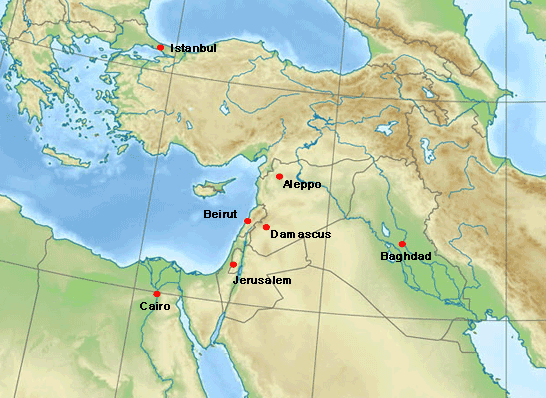
Our community consists of Jewish immigrants that came from the following locations:
JERUSALEM
Ades Synagogue of
Jerusalem
ALEPPO ("HALAB")
History
Syrian Jews
Aleppo Codex Website
Central
Synagogue of Aleppo
DAMASCUS
("JOBAR")
History
BAGHDAD ("HILLAH")
History
CAIRO
History
Historical Society of Jews from Egypt
BEIRUT
History
ISTANBUL
History
Jewish Refugees Blog
In
"Ohel Yesharim" (Livorno, 1822), by
Hakham Abraham Antebi (1765-1858), the chief rabbi of Aleppo, there is a final
chapter called "Sha'ar HaShir," where he discusses the problem of people going out
to cafes to listen to secular Arabic/Turkish music. To combat this, he wrote
pizmonim set to the popular Arabic melodies. Similar words were written by
Hakham Mordekhai Abadi (1826- ) in his “Sha’ar HaShir” which served as an introduction to
“Miqra Qodesh” (
The specific details of how our
Sephardic Hazzanut gradually originated are unknown to us.
Many piyyutim (liturgical poems)
are found in Mahzor Aram Soba 1527 and 1560, but there is no indication that
these piyyutim had different melodies, specifically the melodies of secular
Arabic songs. Over time, the use of piyyutim got eliminated from the prayers,
except for the High Holidays.
Earliest forms of Syrian pizmonim
are from H Israel Najara of 17th century
Some of the names that we know of
from 19th century Aleppo are: H Ezra Attiah (Sassoon Manuscript #609), H
Mordekhai Labaton, H Abraham Antebi ("Ohel Yesharim"), and H Mordekhai Abadi
("Miqra Qodesh"), H Yosef Sitehon, H Ya’aqob Abadi, H Shaul El-Abyad, H Eliahou
Dahab, H Eliahou Hamaoui, H Abraham Sitehon, H Shemuel Moursiyeh, H Menashe
Sitehon, H Eliahou Sasson, H Yehudah Attieh, H Nissim Lofez, H David Kassin, H
Ezra Swed, H Shelomo Menaged, ETC.
Many handwritten pizmonim
manuscripts from the 19th century are available to us, and in these manuscripts
there are hints as to what customs prevailed in
The hazzanut traditions of
The collection of Baqashot,
supplementary poems recited early on Shabbat mornings, has evolved for over two
hundred years. Close to half of todays Baqashot were written somewhere in the
150 year period from 1765-1915. That's to say that 200 years ago the Baqashot
repetoire was a lot shorter or consisted of songs which we do not have today.
Some of the oldest poems used in the Baqashot are from pre-Inquisition
Hakham Raphael Yisshaq Ades
Antebi Tabbush and Hakham Moshe Yosef Ashear Hakohen, both born and raised in
H Raphael Tabbush was born around
1854. He was blind from a young age. He was very famous for the pizmonim he
wrote. Tabbush had many students. He used to teach in Midrash 'Aboud Harari in
Halab and he visited the Talmud Torah often to test out boys that he felt had a
capable future in hazzanut and pizmonim. His first book, “Shirah Hadashah,” was
published in
H Moshe Ashear was born at the
end of 1877. He was one of Tabbush’s favorite and closest students. Ashear wrote
down many of Tabbush's songs because Tabbush was blind. In 1904, he became the
Hazzan and Qore in Knis Kbireh until 1913 when he moved to
In
Syrian Jewish emigration divided
them into a few groups: New York City is the largest group, Mexico City, Buenos
Aires, Panama City, and throughout Israel. There is very little interaction
between the Syrian Jews of New York with those living in
At Magen David Congregation of
Ashear was getting older and the community did not know who to replace him with. They approached Ashear and he said “What do you have to worry about? Just take Nissim Franco!” Ashear passed away in October 1940 on the second day of Hol Hamoed Sukkot.
Isaac Cabasso's father, Ya'aqob Cabasso was also a student of Tabbush and he accompanied him on numerous occasions from Arab musical venues. When they would leave, Tabbush would compose pizmonim to the songs they just heard while walking home.
According to Aharon S Hamaoui, Rabbi and Cantor of Sephardic Community of Greater Boston, his grandfather, Eliahou Hamaoui was also a student of Tabbush who would escort him and record new pizmonim.
In the 1950’s, Eliyahou Menaged, also a student of Tabbush, would record many rare pizmonim with his students, Haim Kairey, Mickey Kairey and Isaac Cabasso. Others who recorded materials include: H Ezra Sayegh, Selim Salem, and Ezra A Tawil.
After Ashear passed away, the hazzan of Magen David was Naftali Tawil but that was short lived (who soon after became hazzan at Congregation Ahi Ezer). He was succeeded by Nissim Franco (who was previously at Knis Betesh) who was then succeeded Gabriel A Shrem, who was then succeeded by Meyer Mickey Kairey.
Nissim (Nathan) Franco was born
in
Gabriel Shrem learned most of his knowledge of
pizmonim from his uncle Abraham Chehebar, born in
At Magen David on Shabbat during Seudah Shelishit, some chairs would be set up by the Hekhal and pizmonim were sung by Abraham Massry and his brother Isaac, Haddad, Mishan, Menaged. If there were any other capable Hazanim, they would join in as well. This custom continues to take place in many synagogues.
The pizmonim tradition was easier to perpetuate during this time period, because the people were more attached to their Syrian ancestry and would congregate with one another on Saturday nights to have Haflah parties where pizmonim would be sung with accompanied music. In addition, there were more pizmonim being sung and taught at Sebbits on Shabbat afternoon.
At Young Magen David, the main hazzan was Ezra A Tawil, and he was assisted by his brothers, Isaac and Moe. The prayers there were always very nice, Isaac Cabasso recalls, especially on the High Holidays. Other helpers there were Jack Abadi and his brother Raymond, as well as Joe Saff. There of course was also Saul Tawil and his brother, Mac Tawil, who read Sefer Torah.
The hazzan at Congregation Shaare Zion was Nissim Franco, then Ralph Marcus, then Rabbi Raphael Elnadav from 1960-1979. Mr Edward Farhi and David Shiro are currently officiating in the dome of Shaare Zion. The Ba'al Qoreh of Shaare Zion is Mac Tawil. Cantors of Bnai Shaare Zion are Haim Eliahou and Solomon I Dayan.
The hazzanim at Congregation Ahi
Ezer were Naftali Tawil, then Ezekiel Hai Albeg, then Meir Levy. Naftali Tawil
passed away at the early age of 61 in 1963. Ezekiel Albeg was a composer of many
beautiful pizmonim as well as the editor of Siddur 'Shabbat Shalom' and Mahzor
'Shelom Yerushalayim' (Rosh Hashana, Yom Kippur, Sukkot). Albeg departed from
The cantors at Ahaba VeAhva
Congregation of
The cantors in Congregation Kol
The cantors in Sephardic Synagogue (Avenue R) were: Eli Marcus, Murray Dweck (first minyan), Joseph Mosseri, Victor Esses. Ba'al Qoreh: Abe Zami, Steven Salem, Nathan M Dweck.
Isaac Cabasso, cantor of Congregation Beth Torah since the 1960s, was approximately 15 years old when Ashear passed away in 1940. According to Eli Moshe Ashear, Isaac Cabasso’s style of hazzanut is most similar to his father’s style. Yehezkel Zion is also the cantor in Congregation Beth Torah.
The publication of "Shir Ushbaha Hallel VeZimrah" was a major community project. In the late 1950’s, a committee was formed by the Magen David Publication Society (eventually to become the Sephardic Heritage Foundation), to create a new pizmonim book to better reflect the community of Brooklyn and to preserve the many pizmonim that has been accumulated over the years from various community member family occasions. The people listed by Gabriel A Shrem, editor-in-chief, as being part of the pizmonim book committee were: Rabbi Dr Jacob S Kassin, Hazzan Raphael Yair Elnadav, Hakham Ezra Mishaniye, Hazzan Ralph Marcus, Hazzan Ezekiel Hai Albeg, Hazzan Isaac J Cabasso, Hakham David Yeshaya Salem, Mr Sam Catton (publisher), Mr Albert Moshe Ashear, Mr Ralph Saul Tawil, Mr Ralph Joseph Sutton, Mr Jack Ezra Hamway, Mr Jack Mordekhai Maslaton, Mr Jack Isaac Hanono ‘Ben Dayan’, Hymie Kairey, Abraham Ezra Azar (Cohen), Moshe Paredes, Eliahou Belilous, Gabriel A Shrem. In order to publish the book, Shrem needed to be granted full permission from one of the descendants of H Moshe Ashear. Mr Charlie Seruya, the leader of Young Magen David, was very instrumental in the outstanding sales and distributions of the new pizmonim book.
The people who decided which songs to include from the songs of Raphael Tabbush are: Hakham Ezra Mishaniye, Hazzan Ezeqiel Hai Albeg, Hazzan Ralph Marcus, Eliahou Menaged, Naftali Tawil, Gabriel A Shrem. Only about 60% of Tabbush's book were included in the new publication in order to make room for some of the newer songs.
In 1964, “Shir
Ushbaha Hallel VeZimrah” was published in
The material of this publication (text, history, and recordings) is currently being preserved by the Sephardic Pizmonim Project on www.pizmonim.com.
In recent years, a wave of
Israeli-trained cantors from Knis Ades,
Another phenomenon of recent years have been the "dumbing
down" of the Hazzanut. For recreation, the average community member does not
listen to Arabic music, but rather Top 40 American songs or Ashkenazi/Israeli
music. Many of the older melodies have fallen out of use in favor of the
melodies that "everyone knows". As a result, the majority of cantors apply the
same melodies in hope that they'd achieve widespread participation during the
prayer services. Generally, when the "Maqam of the Week" calls for Maqam Nawah,
the average cantor will apply Maqam Nahwand. The same is true in regards to
Maqam Bayat and Hoseni, and Rast and Mahour. Isaac Cabasso recalls a time when
Maqam Nawah, not Nahwand, was always applied on Friday nights by Hazzan Ezra A
Tawil in Young Magen David.
| Section | Pizmon | Page | Song | Commentary | Recordings | Application |
|---|---|---|---|---|---|---|
| Mossaei Shabbat | 77 | 94 | אליהו בל כרמל | Judeo-Arabic. Mentions the different locations that were the sister communities of Aleppo. Jobar is a place where Eliyahu HaNavi hid. |
G. Shrem G. Shrem |
This
pizmon is sung every Mossae Shabbat.
Translation by Haim Shayo:
"Eliyahu is in the Mea'ara (cave), we shall light for him the Menora, in his
honor read the Torah, us and all his nation.
Eliyahu is in Jobar, his face shines like a precious stone, in his honor read
the Zohar, us and all his nation.
Eliyahu is in Halab, his beard is red like gold, may push away the disgraces,
may he reunite Israel his nation.
Eliyahu is in Beirut, his beard is red like the (yakout), in his honor the Jews
will read [pray], us and all his nation
Eliyahu is in Istanbul, his faces illuminates like the fire, in his presence
they will do the circumcision, us and all his nation.
Eliyahu is in Hilla, his face is white like the fill (a white flower), he will
do for us the tefilla, and he will construct our holy house.
Lucky is the one that talked to him in words, or saw him in dream, and greeted
him and was greeted by him, and saw with his eyes the light of his face."
This is a song in praise and in thanks of Eliyahu Hanabi, therefore it will
list places for which there is a tradition that Eliyahu Hanabi was. In Syria,
JOBAR was well known as such a place in the Damascus region, and in Halab, it
is the Me'arah. This Judeo-Arabic pizmon probably originated in Damascus, although
according to Joey Mosseri, there is more than one version of a similar pizmon.
Alberto Attia recalls hearing this pizmon during his childhood to the melody
of "Ben Adam Ma Lekha Nirdam." He writes that if you analyze the pizmon you'll
see that the first place of prominence is given to Jobar (Damascus). Now, if
one were to be living in Damascus they would likely rank their interaction with
the surrounding cities precisely in the order that one observes in the pizmon.
Observe that in terms of geography, Halab and Beirut are closest and most important
to Damascus [in that order]. Then comes Istanbul and finally Hillah (Baghdad).
Joey Mosseri checked numerous sources in search of "Habib Allah Eliyahu" in
the Halabi tradition, and he only found 1 source, and that source does NOT match
the one above, printed by Gabriel A Shrem in "Shir Oushbahah Hallel VeZimrah."
The "Habib Allah" that is designated as song 76 on pages 92—94 is 100% Baghdadian
as it appears in many Baghdadi sources. The pizmon above "Eliyahou Bi Carmel",
designated song 77 on pages 94-95 does NOT appear in Baghdadi sources.
According to Joey Mosseri, from Halabi sources, there is a song entitled "Shikran
Eliyahou Hanabi" which starts with "Habib allah eliyahou, ‘aziz allah Bar Yohai!"
And that line is the refrain after each of the 32 verses of this song. He first
saw it in a manuscript of H Ezra Mishanieh, then found it printed by H Abraham
Dayan (?-1916) in 1910, who says that he found this among the papers of his
father, H Shaoul Dayan (?-1903).