
April 27, 2024 ~ PESAH. SIGAH/AJAM/BAYAT.
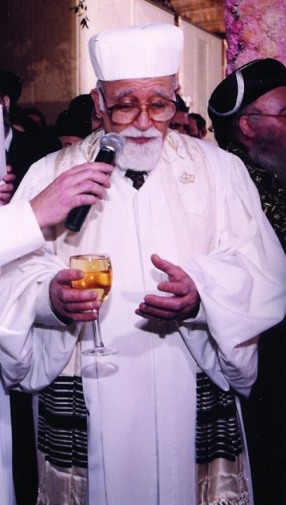
 Raphael
Yair Elnadav was born in Jerusalem to a prominent Yemenite rabbinical
family that had immigrated to Jerusalem around the turn of the 20th
century. As a young man, Hakham
Raphael studied in Yeshivat Porat Yosef in Jerusalem’s Old City.
He studied hazzanut under the celebrated Sephardic Hazzan Yaakov
Levi. At the Conservatory Arzi
Israeli in Jerusalem, he received advanced training in voice development, in
violin and in theory and harmony of music. Under
the aegis of Professor Moshe Cordova, he mastered the many maqamat of
Oriental music. Simultaneously,
he continued his Torah learning in Jerusalem’s Yeshivat Shaare Zion under
Chief Rabbi Ben-Zion Uziel. He earned semicha
(rabbinical ordination) from Rabbi Eliezer Waldenberg
(1915-2006).
Raphael
Yair Elnadav was born in Jerusalem to a prominent Yemenite rabbinical
family that had immigrated to Jerusalem around the turn of the 20th
century. As a young man, Hakham
Raphael studied in Yeshivat Porat Yosef in Jerusalem’s Old City.
He studied hazzanut under the celebrated Sephardic Hazzan Yaakov
Levi. At the Conservatory Arzi
Israeli in Jerusalem, he received advanced training in voice development, in
violin and in theory and harmony of music. Under
the aegis of Professor Moshe Cordova, he mastered the many maqamat of
Oriental music. Simultaneously,
he continued his Torah learning in Jerusalem’s Yeshivat Shaare Zion under
Chief Rabbi Ben-Zion Uziel. He earned semicha
(rabbinical ordination) from Rabbi Eliezer Waldenberg
(1915-2006).
In 1950, Elnadav married Bertha (Batia) Hassoun, and they settled in Tel Aviv where he was appointed chief hazan in Congregation Ohel Moed, the main Sephardic synagogue of Tel Aviv. Their eldest son, Yosef, was born soon after. By then, he had earned widespread acclaim in the world of hazzanut as a talented innovator, composer and expert in Sephardic liturgy.
He was only 34, but tremendously accomplished – a shohet (ritual slaughterer), mohel, hazzan and rabbi – when the life-altering job offer came. An emissary from Cuba’s Sephardic community arrived in Israel, having been sent for the sole purpose of offering Rabbi Elnadav the leadership of the community. After months of negotiation and deliberation, in 1955 Elnadav agreed to take the position in Havana and served the Cuban community at every level – leading the prayers, performing marriages, funerals, answering halachic queries and supervising kashrut in Cuba, overseeing the shehita process twice a week.
When Congregation Shaare Zion on Ocean Parkway in Brooklyn was in its planning stages, Mr. Isaac Shalom a’h spoke to Rabbi Elnadav and expressed his hope that the young hazzan would consider a position in the Syrian community once the Shaare Zion building was complete. In 1959, together with his two children (the youngest, Esther, was born later, in America) and parents-in-law, he moved to New York and assumed the position of Chief Cantor, a post he held for 21 years until his retirement in 1980.
| Section | Pizmon | Page | Song | Commentary | Recordings | Application |
|---|---|---|---|---|---|---|
| Baqashot | 61 | 69 | ידיד נפש |  Elazar Azkari Maqam Sigah 16th century. He defines this piyut as “a supplication for union and the desire of love”. Sigah. A Z Idelsohn notes, 1923 Aharon Rahamim Hares Baqashot Manuscript, 1917 Elazar Azkari Maqam Sigah 16th century. He defines this piyut as “a supplication for union and the desire of love”. Sigah. A Z Idelsohn notes, 1923 Aharon Rahamim Hares Baqashot Manuscript, 1917 |
R Elnadav |
ממצרים |
| Rast | 155.03 | 132a | אל חביב |  |
R. Elnadav R Elnadav |
|
| Rast | 155.04 | 132b | חי אל נאדר | Haim S Aboud |
R. Elnadav |
|
| Rast | 167.01 | 144a | אנא יה חביבי |
R. Elnadav R Elnadav |
||
| 167.1 | 142l | דגלי תשא על הרי | Haim S Aboud Maqam Rast |
R. Elnadav |
||
| Ajam | 254.5 | 204a | יום זה ישיר ירון | Raphael Yair Elnadav Bar Misvah of Morris Mickey Abraham. 1981. Photograph of Morris Mickey Abraham |
R. Elnadav |
|
| Nahwand | 265 | 210 | אתה אל כביר | Raphael Tabbush The initials at the beginning of each stanza form the acrostic 'Ani Refael'. The song talks about Israel's redemption. The beginning of the pizmon has the composer turning to God to ask for mercy. The composer says that he will not stop praying until his prayers are accepted. He prays for the redemption of the Jewish people, the gathering of the exile, and returning to the Land of Israel. Tabbush Manuscript |
R. Elnadav R Elnadav |
נשמת |
| Nahwand | 271 | 213 | אחזה בנועם | Raphael Tabbush "Ehze BeNoam" (NAHWAND, page 213), translated as "I will gaze at the pleasantness of Your face," is a song written by master composer, H Raphael Antebi Tabbush (d. 1918). The 6 stanzas of the song form the acrostic: "Ani Refael" (אני רפאל). Though a favorite at the Shabbat afternoon Sebbits, this melody is almost never applied to any of the pieces of prayers. This composition describes what the author envisions he will do once he leaves the exile; dwelling in the House of the Lord, bowing in the holy sanctuary, and offering the burnt sacrifice in the Temple. He then asks for the Blessing of Abraham and not to be humiliated while in exile. He continues by asking for God to hasten the redemption for the Jewish nation. The battered Jewish nation, at times, feels "chained" (עגונים) in their exile, but finds comfort in their study of the Torah. The author asks God to accept the praises and songs of His beloved nation, because He is a merciful God that forgives transgressions and is eternally kind. Tabbush Manuscript |
R Elnadav |
פזמון |
| Nahwand | 299.02 | 237b | החיש לצירך | Haim S Aboud |
R. Elnadav R Elnadav |
|
| Nahwand | 299.06 | 237f | הדור שומע | Raphael Yair Elnadav Jack D. Hidary Bar Misvah. Photograph of Jack David Hidary |
R. Elnadav |
|
| Bayat | 346 | 266 | אל מאד נעלה | Moses Ashear The pizmon “El Meod Na’ala” (BAYAT, page 266) is one of the most famous compositions written by cantor H Moshe Ashear (1877-1940). This was written in honor of the groom Mr Elie J Gindi (born in 1900, Syria) for his wedding (circa 1924 in Brooklyn, NY). The acrostic of the pizmon is “Eliah Moshe” with the first word of each of the three stanzas spelling “Eliah” and the second word of each stanza spelling “Moshe.” The names of the bride’s father, Moses (Attieh), and the bride, Rachel, are alluded to in the first and third stanza’s respectively. The melody of this pizmon is from polka music from Istanbul, Turkey. In the prayers, this melody is commonly applied to Semehim on weeks of Maqam BAYAT. This song is also traditionally used as the PIZMON SEFER TORAH for Shabbat Shemot because of it mentioning Moshe and Aharon, two important people introduced in this Torah portion. Ashear Manuscript |
R. Elnadav |
שמחים |
| Bayat | 391.05 | 318c | קולי שמעה |
R. Elnadav |
אל ההודאות | |
| Bayat | 391.06 | 318d | יקרך ישירו | |
R. Elnadav |
|
| Hoseni | 430.01 | 353a | אל המרומם על כל ומתנשא | Raphael Yair Elnadav Bar Misvah of Murray David Hidary (1984). |
R Elnadav |
|
| Sigah | 521 | 437 | יונה יקושה | יום טוב Attiah Manuscript Yabess Manuscript Abraham Sitehon Manuscript Mosseri-Kozli Manuscript |
R. Elnadav |
|
| 742 | 353e | אפצחה פי בשירה וזמרה | Raphael Yair Elnadav Maqam Bayat Special pizmon to welcome Chief Rabbi of Israel, Maran Hakham Obadia Yosef, to the United States (1996). |
R Elnadav |
||
| Berakhot | ברכות | 540 | השכבות | Raphael Yair Elnadav Hashkabot are said for the deceased at the funeral. |
R. Elnadav- Hashkava at Funeral of H Yaakob S Kassin, 1994 R. Elnadav- Hashkava at Funeral of H Matloub Abadi, 1970 |
|
| 2192 | 353c | גיל ורון | Raphael Yair Elnadav Maqam Kourd Bar Misvah of Miro Isaac Sutton. Composed by H Raphael Y Elnadav. |
R Elnadav |
||
| Pentateuch | 3498.5 | P2 | הוצאת ספר תורה |
R Elnadav- Ashre Ha'Am |
||
| 4027 | 353b | אור צח קדוש ונעלם | Haim S Aboud Maqam Bayat In honor of "Hebrat Hobebei Shirah" |
R Elnadav |
| Section | Pizmon | Page | Song | Commentary | Recordings | Application |
|---|---|---|---|---|---|---|
| Rast | 166 | 143 | רננות שיר ושבחה | Gindi Bar Misvah. |
I. Cabasso |
|
| Ajam | 254.5 | 204a | יום זה ישיר ירון | Bar Misvah of Morris Mickey Abraham. 1981. Photograph of Morris Mickey Abraham |
R. Elnadav |
|
| Nahwand | 299.04 | 237d | רוממו לו בקול | Composed for the Bar Misvah of Ezra Tawil to the melody of "Inta al-Hubb", a popular Arab song performed by Umm Kulthum. |
Arabic Recording Agudat Dodim (Buenos Aires)- Mimisrayim Moshe Dwek - Rau Banim |
|
| Nahwand | 299.06 | 237f | הדור שומע | Jack D. Hidary Bar Misvah. Photograph of Jack David Hidary |
J. Mosseri R. Elnadav |
|
| Nahwand | 299.1 | 237j | אל על שיר גיל נרון | Bar Misvah of Saul Ezra Ashkenazi. Composed by R Elnadav. 1984. |
M Habusha Recording |
קדיש |
| 299.101 | באר ציון | Maqam Nahwand |
 M Habusha M Habusha |
|||
| Nahwand | 299.102 | 237t | על הרי על הרי | Bar Misvah of Harry E Tawil. 1996. Composed by R Elnadav. Maqam Nahwand-Kurd |
M Habusha Recording |
קדיש |
| Hoseni | 430.01 | 353a | אל המרומם על כל ומתנשא | Bar Misvah of Murray David Hidary (1984). |
R Elnadav |
|
| 742 | 353e | אפצחה פי בשירה וזמרה | Maqam Bayat Special pizmon to welcome Chief Rabbi of Israel, Maran Hakham Obadia Yosef, to the United States (1996). |
R Elnadav |
||
| Berakhot | ברכות | 540 | השכבות | Hashkabot are said for the deceased at the funeral. |
R. Elnadav- Hashkava at Funeral of H Yaakob S Kassin, 1994 R. Elnadav- Hashkava at Funeral of H Matloub Abadi, 1970 H Yaaqob Mizrahi, 1913- Tehiyat Hametim Prayer |
|
| 2192 | 353c | גיל ורון | Maqam Kourd Bar Misvah of Miro Isaac Sutton. Composed by H Raphael Y Elnadav. |
R Elnadav |
